6 Handling Steps for Potting a String of Pearls
String of pearls (Senecio rowleyanus) trails best when potted with intention. The pea-shaped leaves demand gritty substrate, shallow containers, and minimal root disturbance. Following the proper steps for potting a hanging string of pearls prevents rot, encourages adventitious rooting along stems, and maintains the cascading architecture that defines this succulent. Each handling decision affects auxin distribution and the plant's ability to produce new growth nodes along the trailing stems.
Materials
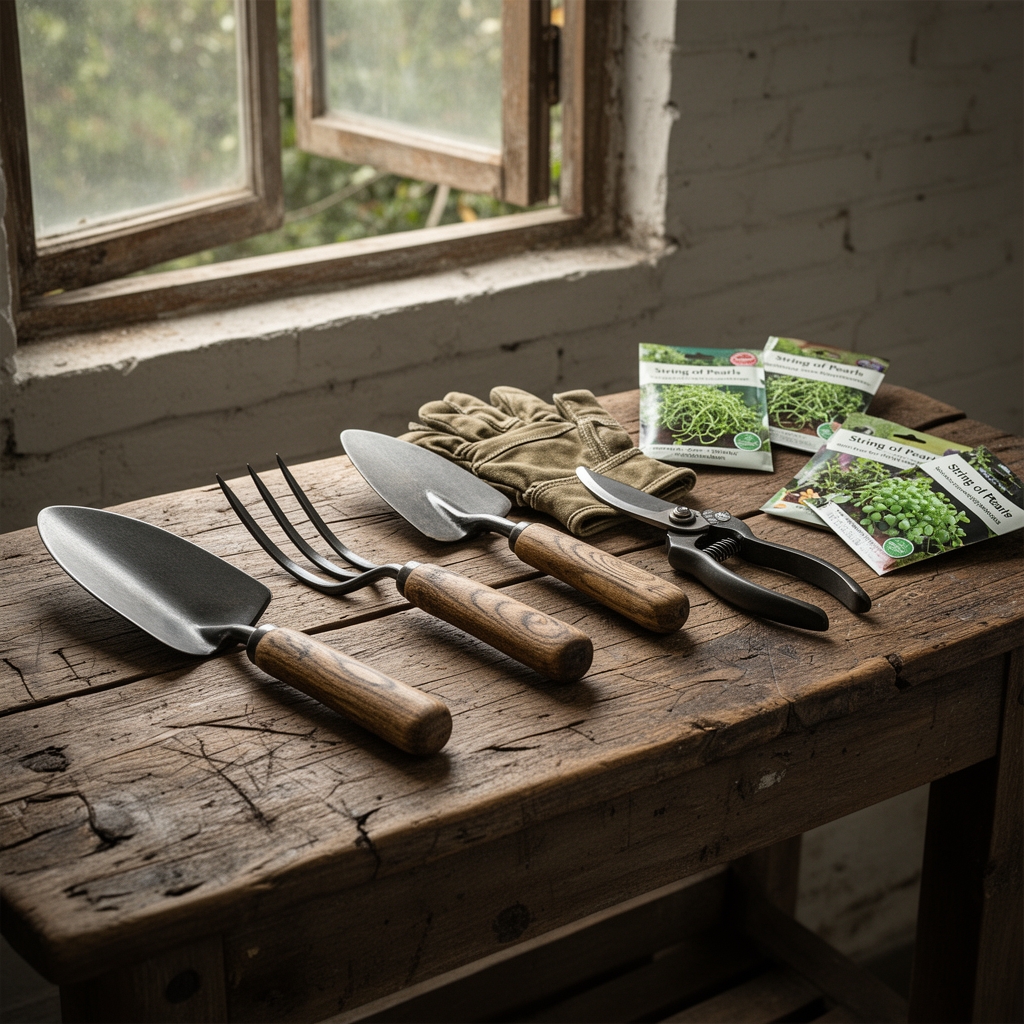
Substrate composition determines survival rates. Combine three parts coarse sand (2-5mm grain size) with two parts cactus mix and one part perlite. Target pH sits between 6.0-6.5. This range optimizes cation exchange capacity without locking out micronutrients. Fertilizer should deliver balanced NPK ratios near 2-2-2 or 4-4-4 at quarter strength. Avoid nitrogen-heavy formulations above 10-5-5 ratios, which produce weak, etiolated strands prone to snapping.
Select containers with drainage holes measuring at least 8mm diameter. Hanging baskets 6-8 inches wide and 4-5 inches deep provide adequate volume without waterlogging the shallow root system. Terra cotta offers superior gas exchange compared to glazed ceramic. Wire hangers should support 3-5 pounds when substrate reaches field capacity.
Rooting hormone powder containing 0.1% indole-3-butyric acid accelerates establishment. Mycorrhizal fungi inoculants (Glomus species) colonize roots within 14 days and improve phosphorus uptake by 40 percent in low-nutrient substrates.
Timing
String of pearls tolerates USDA Hardiness Zones 9-11 outdoors year-round. Indoor potting occurs any time ambient temperatures remain above 50°F. Optimal root development happens when soil temperatures hold steady between 65-75°F. Avoid potting during active bloom cycles, typically late spring through early summer.
In Zone 8 and colder regions, pot six weeks after the last frost date. This window allows root establishment before summer heat stress. Indoor specimens benefit from potting in early spring when increasing photoperiods stimulate auxin production and meristematic activity.
Phases
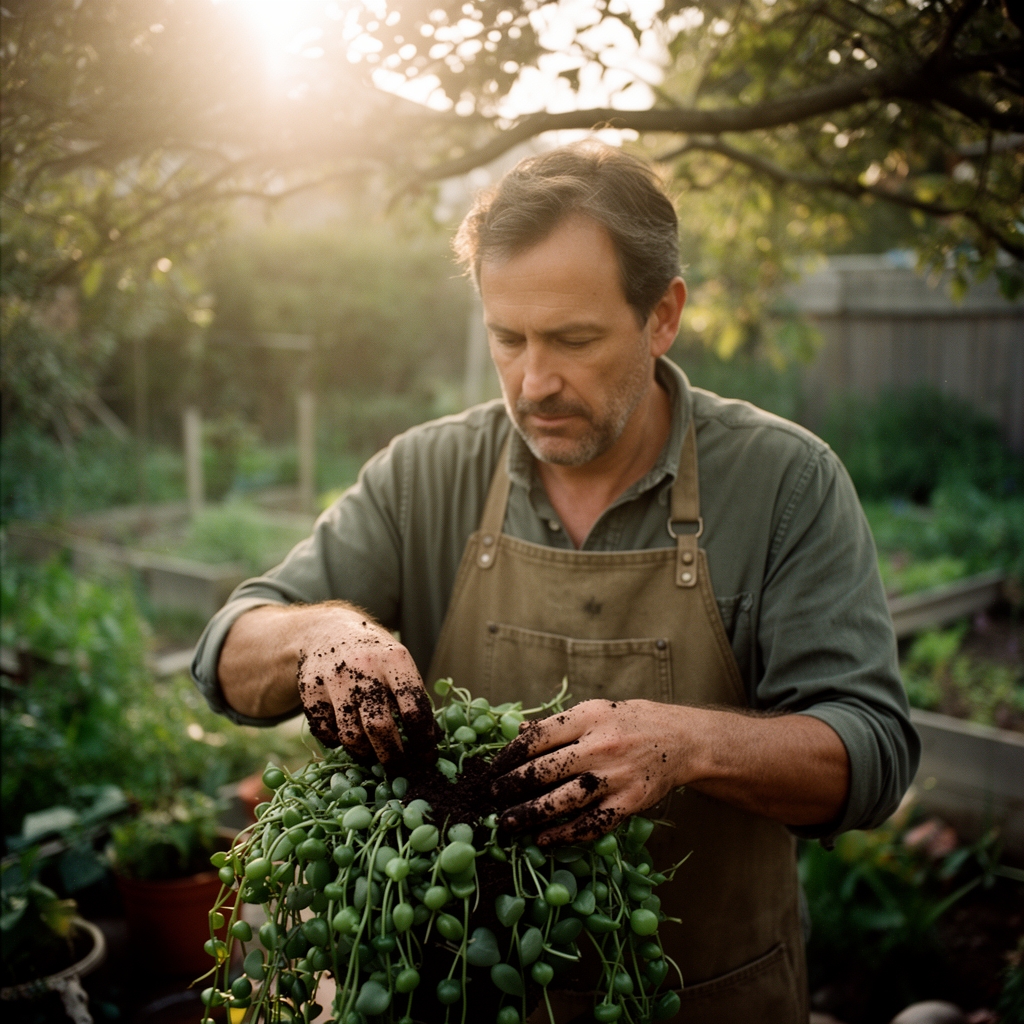
Propagation Phase
Remove 3-4 inch stem cuttings with sterile pruning shears. Each cutting must contain at least six healthy pearls. Strip the bottom two pairs of leaves to expose nodes. Dip cut ends in rooting hormone powder for three seconds. Insert cuttings 0.5 inches deep into pre-moistened substrate, spacing them 1 inch apart around the container perimeter.
Pro-Tip: Lay entire stem sections horizontally across substrate surface and pin every 2 inches with bent wire. Nodes in contact with soil produce roots within 10-14 days, creating fuller plants faster than vertical insertion.
Transplanting Phase
Water the donor plant 24 hours before extraction. Grip the base of trailing stems near the soil line. Tilt the container and slide the root ball out intact. Senecio rowleyanus develops shallow, fibrous roots concentrated in the top 2 inches of substrate. Preserve this root zone without teasing or spreading.
Position the root ball in the new container so the crown sits 0.25 inches below the rim. Fill gaps with prepared substrate, tamping gently to eliminate air pockets. Avoid burying stems deeper than their original depth. Excess substrate against stems invites crown rot from Pythium and Phytophthora species.
Pro-Tip: Dust exposed roots with mycorrhizal inoculant immediately before placing in the new container. Direct root contact ensures colonization before substrate particles block hyphal access.
Establishment Phase
Place potted specimens in bright, indirect light providing 2000-4000 foot-candles. Avoid direct afternoon sun for the first 14 days. Water only when the top inch of substrate reaches dry to the touch, approximately every 10-12 days depending on humidity. Initial waterings should deliver 4-6 ounces for a 6-inch container until runoff appears.
Monitor for new growth at nodes within three weeks. Pale green shoots indicate successful establishment. Resume normal care protocols after six weeks when roots have colonized 80 percent of available substrate volume.
Pro-Tip: Rotate containers 90 degrees weekly during establishment. Phototropic response distributes auxins evenly, preventing lopsided growth that stresses anchor roots.
Troubleshooting
Symptom: Shriveled, deflated pearls with wrinkled epidermis.
Solution: Underwatering. Increase frequency to every 7 days. Substrate should dry to 1.5 inches deep, not bone dry throughout.
Symptom: Translucent, mushy pearls with stem collapse.
Solution: Overwatering combined with poor drainage. Repot into grittier mix with 50 percent inorganic material. Water only when moisture meter reads below 3 at root depth.
Symptom: Brown, crispy leaf tips progressing from strand ends.
Solution: Salt accumulation from fertilizer. Flush substrate with distilled water at twice container volume. Reduce fertilizer concentration to 1-1-1 NPK ratio monthly.
Symptom: Cottony white masses at leaf axils.
Solution: Mealybug infestation (Pseudococcidae family). Dab colonies with 70% isopropyl alcohol on cotton swabs. Apply neem oil at 2% concentration weekly for three applications.
Symptom: Leggy strands with 1-2 inch spacing between pearls.
Solution: Insufficient light intensity. Move to location receiving 4000-6000 foot-candles or supplement with LED grow lights at 12-inch distance for 12 hours daily.
Maintenance
Water when the top 1 inch of substrate feels dry, typically every 9-14 days depending on season. Deliver 6-8 ounces per 6-inch container until drainage occurs. Reduce frequency by 30 percent during winter dormancy when temperatures drop below 60°F.
Fertilize monthly during active growth with diluted liquid fertilizer at 2-2-2 NPK ratio, applying 4 ounces per container. Cease fertilization from November through February in the Northern Hemisphere.
Prune dead or damaged strands at the crown using sterilized shears. Cut at 45-degree angles to minimize wound surface area. Trim straggly growth by 2-3 inches each spring to encourage lateral branching.
Repot every 24-36 months or when roots circle the container perimeter. String of pearls prefers slight root restriction. Increase container size by only 1-2 inches in diameter per transplant.
FAQ
How deep should string of pearls be planted?
The crown sits level with or slightly above the substrate surface. Burying stems invites fungal infection. Roots develop 0.5-2 inches below the soil line.
Can you propagate string of pearls in water?
Yes, but substrate establishment succeeds more reliably. Water-rooted cuttings experience 30 percent transplant shock when moved to soil. Direct substrate propagation eliminates this transition stress.
Why are my string of pearls dying after repotting?
Root damage or overwatering. This species develops limited root mass. Handle roots minimally and water sparingly for 14 days post-transplant.
What size pot for string of pearls?
Six to eight inch diameter containers suit mature specimens. Shallow depth of 4-5 inches prevents moisture accumulation below the root zone.
How often should I water newly potted string of pearls?
Every 10-12 days for the first six weeks. Check substrate moisture at 1.5 inch depth. Water only when dry at this level.