7 Success Tips to Use an Indoor Seed Heating Mat
The first warmth of spring arrives weeks late for gardeners who skip a simple tool. Seeds sit inert in cold soil, embryos locked in metabolic suspension while ambient temperatures hover below activation thresholds. Using a heating mat for indoor seed starting changes this equation entirely. A consistent 70-80°F substrate temperature accelerates germination by 40-60% across most vegetable and ornamental species. The difference between a two-week wait and a five-day sprout often rests on controlled bottom heat alone.
Materials
Quality seed starting requires stratified inputs matched to substrate chemistry and thermal conductivity.
Heating Mat (Thermostat-Controlled)
Select units with adjustable thermostats maintaining 68-85°F. Fixed-temperature models often overshoot optimal ranges for brassicas and lettuce.
Seed Starting Mix (pH 5.5-6.5)
Combine 40% Canadian sphagnum peat, 30% perlite, 20% vermiculite, and 10% worm castings. This blend achieves cation exchange capacity of 15-20 meq/100g while maintaining porosity above 60%. Avoid garden soil; its thermal mass delays warming and harbors damping-off pathogens.
Nutrient Amendment (4-4-4 Organic)
Apply kelp meal and bone char at 1 tablespoon per gallon of mix. Nitrogen drives auxin production in emerging hypocotyls. Phosphorus supports root initiation within 72 hours of radicle emergence.
Trays and Domes
Use 72-cell plug trays for small seeds, 36-cell for tomatoes and peppers. Clear humidity domes trap transpired moisture, maintaining 85-95% relative humidity until cotyledons expand.
Digital Thermometer
Probe-style models measure substrate temperature at 1-inch depth. Surface readings mislead by 8-12°F in active heating scenarios.
Timing
Indoor seed starting calendars pivot on last frost dates and species-specific maturation windows.
Zone 3-4 (Last Frost: May 15-June 1)
Start tomatoes and peppers 8-10 weeks prior, typically March 1-15. Brassicas require only 6 weeks; begin April 1. Excessive lead time produces leggy, root-bound transplants with compromised field performance.
Zone 5-6 (Last Frost: April 15-May 15)
Peppers and eggplant need 10-12 weeks of indoor growth. Initiate February 15-March 1. Lettuce and kale tolerate light frost; start 4 weeks before last date.
Zone 7-8 (Last Frost: March 15-April 15)
Short indoor phases suffice. Heat-loving crops like basil and cucurbits start 4-6 weeks early. Cool-season crops direct-seed outdoors in most years.
Substrate Temperature Targets
Tomatoes germinate optimally at 75-80°F. Peppers demand 80-85°F. Lettuce and brassicas prefer 65-70°F. A single mat cannot serve all species simultaneously without zonal partitioning.
Phases
Sowing
Fill cells to 0.5 inches below rim. Firm mix gently; bulk density should reach 0.3-0.4 g/cm³. Plant seeds at depth equal to twice their diameter. Cover with vermiculite to maintain moisture contact without crusting.
Set mat thermostat to species-specific target. Place trays directly on mat surface. Install humidity dome, leaving corner vents open 0.25 inches for air exchange. Check substrate temperature at multiple points; variance exceeding 5°F indicates uneven heat distribution or mat failure.
Pro-Tip: Incorporate Trichoderma harzianum at 10^6 spores per cubic foot of mix. This beneficial fungus colonizes developing roots, suppressing Pythium and Rhizoctonia while enhancing phosphorus uptake by 18-22%.
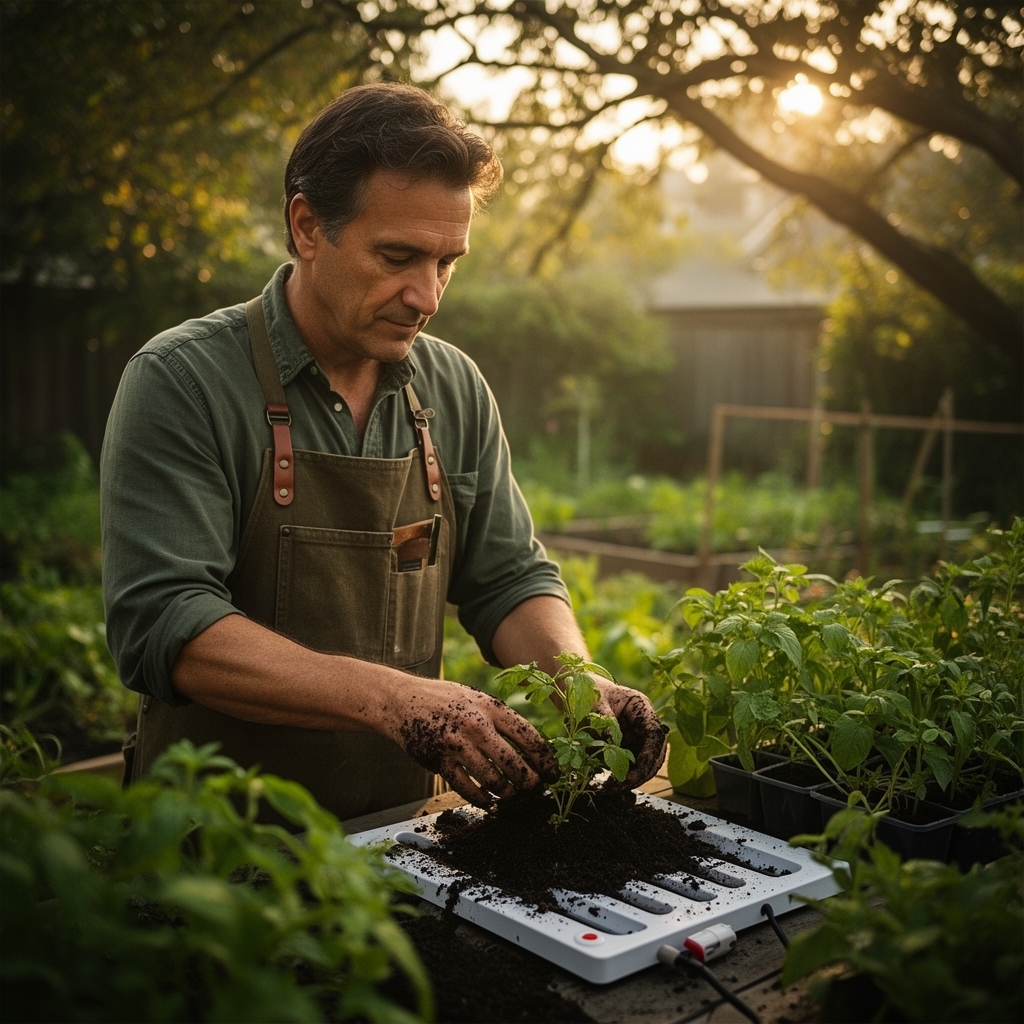
Transplanting
Remove dome when 80% of seeds show cotyledon emergence. Decrease mat temperature by 5°F to prevent stem elongation. Position full-spectrum LED grow lights 4-6 inches above canopy, delivering 200-400 µmol/m²/s for 14-16 hours daily.
Transplant to 4-inch pots when true leaves number two to four. Handle only by cotyledons; stem damage disrupts auxin distribution and invites infection. Use potting mix amended to 8-8-8 slow-release granules at manufacturer's rate.
Pro-Tip: Prune tomato seedlings at 45-degree angle when transplanting, burying stem up to lowest true leaves. Adventitious roots emerge from buried nodes within 96 hours, doubling root mass.
Establishing
Harden off transplants over 7-10 days. Begin with 2 hours of filtered outdoor light, increasing by 1 hour daily. Night temperatures should remain above 50°F for warm-season crops, 35°F for cool-season types.
Discontinue heating mat use once soil temperatures stabilize at 60°F outdoors. Monitor soil moisture; transplant shock peaks when root-to-shoot ratio drops below 1:3.
Pro-Tip: Foliar spray with seaweed extract (1:500 dilution) 48 hours before field transplanting. Cytokinins in kelp reduce transplant shock by 30% and accelerate lateral root initiation.
Troubleshooting
Symptom: Damping-off (seedling collapse at soil line)
Solution: Reduce humidity to 70%. Increase air circulation with small fan. Drench substrate with chamomile tea (1:10 dilution) for mild antifungal action.
Symptom: Leggy seedlings (elongated hypocotyls, pale stems)
Solution: Lower mat temperature by 5-8°F. Increase light intensity to 400-600 µmol/m²/s. Reduce photoperiod to 12-14 hours to slow gibberellin synthesis.
Symptom: Algae on substrate surface (green film)
Solution: Top-dress with 0.25-inch layer of coarse perlite. Decrease watering frequency. Algae competes for nitrogen but poses no direct seedling threat.
Symptom: Helmet head (seed coat stuck on cotyledons)
Solution: Mist affected seedlings twice daily. Remove dome prematurely; 90%+ humidity softens seed coats naturally during emergence.
Symptom: Fungus gnats (small black flies around trays)
Solution: Allow top 0.5 inch of substrate to dry between waterings. Apply Bacillus thuringiensis israelensis (Bti) drench at label rate. Adults are nuisance; larvae damage fine roots.
Maintenance
Water when substrate surface lightens in color and top 0.5 inch feels dry to touch. Apply 0.25-0.5 cups per 72-cell tray, achieving 20-30% leachate. Bottom watering prevents media displacement but increases salt accumulation; alternate methods weekly.
Fertilize weekly with half-strength liquid solution once true leaves emerge. Target 100-150 ppm nitrogen from fish emulsion or soluble kelp. Excess fertility produces succulent growth prone to aphid colonization and wind damage post-transplant.
Calibrate mat thermostat monthly. Fill test cell with moist substrate, insert probe thermometer, and compare readings after 30 minutes. Replace mats showing variance above 3°F or uneven heating patterns.
Clean trays and domes with 10% bleach solution between crops. Rinse thoroughly; residual chlorine inhibits germination at concentrations above 2 ppm.
FAQ
How long should I keep seedlings on the heating mat?
Remove seedlings when 90% have germinated and cotyledons fully expand, typically 5-14 days depending on species. Continued heat after emergence causes excessive stem elongation.
Can I use a heating mat without a thermostat?
Not recommended. Unregulated mats often reach 95-105°F, killing seeds of most species. Thermostats cost $15-25 and prevent total crop loss.
What if my seeds germinate unevenly?
Check for hot and cold zones using multiple thermometers. Rotate trays 180 degrees daily. Some seed lots show genetic variability; accept 80-85% germination as normal.
Do all vegetables need bottom heat?
No. Lettuce, spinach, and peas germinate well at 60-65°F ambient temperature. Reserve heating mats for warm-season crops with 70°F+ requirements.
How do I prevent mold on seed starting mix?
Maintain air circulation with small fan on low speed. Water in morning hours, allowing surface to dry before nightfall. Mold indicates excess moisture, not contamination.